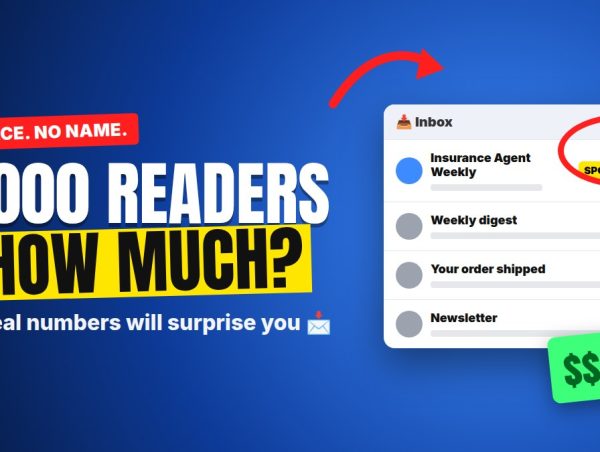
Most people think newsletters only make money at huge sizes. That’s wrong. A small newsletter for the right audience can earn more than a big one for a general audience — because sponsors pay for who reads, not just how many.
And your readers never need to know who writes it. With AI handling research and summaries, one person can run a sharp weekly newsletter in a few hours.
Why niche beats size
Compare two newsletters with 2,000 readers each:
- “Fun facts daily” — readers are everyone. Advertisers pay little.
- “Weekly news for independent insurance agents” — every reader is a business owner who buys software, leads and training. Advertisers pay much more to reach them.
Same size. Very different income. That’s why the niche is the most important decision you make.
How newsletters make money
1. Ad networks
Platforms like beehiiv have built-in ad networks that match newsletters with advertisers. You choose which ads to run and get paid per click or per open. Earnings at small sizes are modest, but it’s automatic.
2. Paid referrals (Boosts)
Some platforms let other newsletters pay you to recommend them to your readers — for example, when someone subscribes to your newsletter, they see recommendations, and you earn for each new subscriber you send.
3. Direct sponsors (the big one)
A company pays you directly for a spot in your newsletter. In specialized B2B niches, even small lists can command meaningful rates because each reader is a potential customer worth hundreds or thousands of dollars.
4. Affiliate links
Recommend tools your readers already need and earn a commission. Always disclose affiliate links.
A realistic look at 2,000 subscribers
| Income source | General niche | Strong B2B niche |
|---|---|---|
| Ad network | Low | Low to moderate |
| Referral payments | Low to moderate | Low to moderate |
| Direct sponsor per issue | Often hard to sell | Can reach the low hundreds of dollars |
| Affiliates | Varies | Can be strong (software) |
The honest truth: at 2,000 readers, a general newsletter often earns little. A well-chosen B2B niche with weekly sponsors can turn into a solid side income. Results depend heavily on the niche, how engaged readers are, and your ability to find sponsors.
5 niches with money behind them
- Independent insurance agents — software, lead-gen and training companies want them.
- Small-town real estate investors — lenders, property tools, courses.
- Dental practice owners — equipment, software, marketing agencies.
- Trucking company owners — fuel cards, insurance, dispatch software.
- Shopify store owners in one category — apps, suppliers, ad agencies.
How AI runs it for you
- Collect sources: industry news sites, trade publications, Reddit communities, government updates.
- Summarize: paste articles into ChatGPT or Claude and ask for a 3-sentence summary plus “why it matters for [audience].”
- Structure: use the same format every week — 3 top stories, 1 quick tip, 1 tool, 1 number of the week.
- Edit: check facts, add your take, keep it short. Readers value a sharp 5-minute read.
Important: always link to the original sources, don’t copy articles, and verify facts before sending. Trust is your whole business.
How to get your first readers
- Share useful summaries in LinkedIn posts and niche Facebook groups (follow group rules).
- Use referral networks on your newsletter platform to grow.
- Offer a free resource (“The 2026 checklist for new insurance agents”) in exchange for signing up.
When to pitch sponsors
Don’t wait for 10,000 readers. Once you have a few hundred engaged subscribers with good open rates, look at who advertises in your industry (trade sites, podcasts, conferences) and pitch them a low-cost test spot. Share your open rate and who your readers are.
It’s the slowest method on our list — but it’s also the only one that builds an asset you could sell one day.
Earnings vary widely and are not guaranteed. Figures are illustrative.