
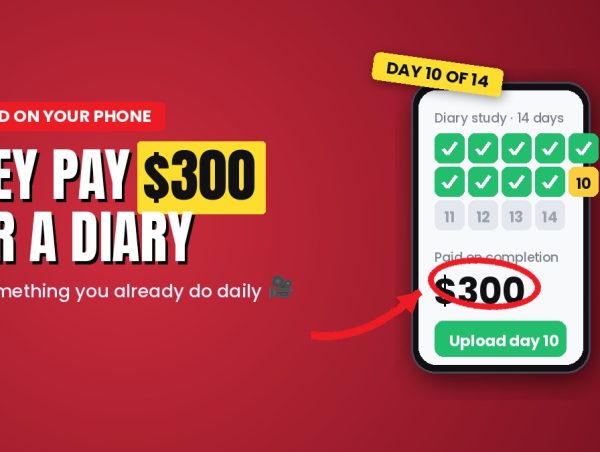
Method #5 on our list of ways Americans get paid to watch videos swaps the live call for your phone camera. Instead of talking to a researcher in real time, you film your own reactions and upload them — sometimes once, sometimes every day for a fortnight.
Testers report three tiers on platforms like Dscout: express missions at $5–$25, video missions at $75–$100, and diary studies at $100–$300. Those are tester-reported figures rather than published rates, so treat them as the shape of the market rather than a price list.
How scout platforms work
You install an app, build a profile, and apply to open “missions.” Each one states what it involves before you accept.
- Express missions — a single short task. Film yourself opening a package, react to a concept, photograph what is in your fridge. Twenty minutes, small payment.
- Video missions — a structured session you record alone. Watch an ad or try a prototype, narrate your reaction, answer prompts on camera. An hour or two.
- Diary studies — the real money. Over one to three weeks you log a recurring behaviour: every time you order food, every time you check your bank balance, every time you use a particular app. Short entries, but the commitment is daily.
The deliverable is always the same thing: footage of a real person being real, which is the one input a company cannot generate internally.
Why diary studies pay what they pay
A $200 diary study is not $200 for a few minutes of work. It is $200 for reliability over two weeks. The entire value collapses if a participant drops out on day nine, because the dataset needs complete sequences, not fragments.
That is why the selection is strict and why the money is good: companies are paying a premium for the small group of people who are known to finish.
What gets a profile picked for the $300 missions
Here is the detail that matters, and it is almost entirely within your control.
Selection is not based on who you are. It is based on your completion record and the quality of your footage — and on a new account you have neither, which is why everyone starts in the $5 pool.
What researchers screen on, in order:
- Completion rate. One abandoned mission is visible on your record for a long time. Never accept a diary study you are not certain you can finish — the small payment you forfeit matters far less than the flag you earn.
- Video quality that is competent, not pretty. No researcher wants production value. They want audible audio, a steady frame, a lit face and no wind. A $15 clip-on microphone and filming near a window puts you ahead of most applicants.
- Answers that explain the “why.” “I used the app” is useless. “I used the app in the car park because I wasn’t sure the payment went through” is the kind of clip that gets cut into a stakeholder reel — and participants whose footage gets used get invited back.
- Response speed to the application. Missions fill. Most are claimed within hours of opening.
Three or four clean express missions is usually enough to start seeing the higher tier. Think of the small ones as paid auditions rather than as the job.
Three things that end a scout account
🚩 Abandoning a diary mid-study
This is the one serious mistake in the category. It damages the research and it is remembered.
🚩 Filming several entries at once
Diary studies are time-stamped specifically to prevent this. Batching a week of entries on Sunday is detected and voids the whole submission.
🚩 Performing for the camera
Participants who narrate like influencers get screened out. The brief is ordinary behaviour, filmed plainly.
Your first month
- Week 1: Install the app, complete the profile fully, apply to every express mission you qualify for.
- Week 2: Complete two or three express missions properly. Buy a clip-on mic. Film near a window.
- Week 3–4: Start applying to video missions. Accept a diary study only when you are confident about the next two weeks.
Is it worth it?
Per hour it sits just below live research interviews and well above everything else on our list. The difference is that it rewards consistency rather than credentials — you can build your way into the high tier, which is not true of a method that needs a specific job title.
If daily commitment doesn’t suit you, website tests deliver a similar rate in 20-minute pieces with no ongoing obligation.
Where it lands against the rest: all seven methods ranked by hourly pay.
Rates shown are published or self-reported figures and are not a guarantee of earnings. This article is for informational purposes only and does not constitute financial advice.