Every method on our list of ways Americans get paid to watch videos is advertised the same way: watch something, get paid. What nobody prints is the rate per hour, because that is where the methods stop looking alike.
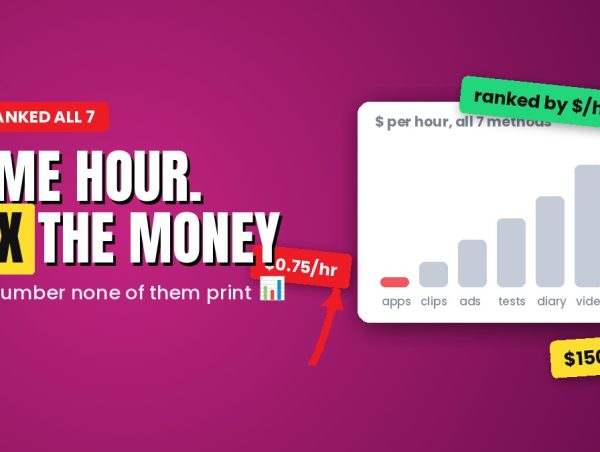
Below is every method ranked by what it realistically pays for an hour of your time, including the unpaid parts — the screeners, the waiting, the profile setup amortised over a month of use.
The ranking
| # | Method | Realistic per hour | How often it’s available |
| 1 | Research interviews & focus groups | $75–$150 | Rare — a few per month at best |
| 2 | Video missions & diary studies | $30–$60 | Occasional |
| 3 | Website tests (talking out loud) | $25–$30 | Weekly, if your profile matches |
| 4 | Consumer ad-rating panels | $10–$20 | Occasional |
| 5 | Captioning & clipping | $8–$20 | On demand — you choose the volume |
| 6 | Reward apps (watching ad clips) | Under $1 | Unlimited, and capped by design |
| 7 | Passive measurement panels | No hourly rate — around $50/year for no work | Continuous |
The spread between #1 and #6 is roughly 40x. Both are described online as “get paid to watch.”
Where those numbers come from
Interviews. Respondent publishes $50 to $400+ for sessions of 30 minutes to two hours; in-person focus groups average $150–$250. A one-hour session at the common $75–$150 band sets the rate. Full breakdown here.
Video missions. Testers report express missions at $5–$25, video missions at $75–$100 and multi-day diary studies at $100–$300. Spread across the hours a diary actually consumes, that lands in the $30–$60 band. These are tester-reported figures, not published rates. Full breakdown here.
Website tests. UserTesting publishes $10 for a 20-minute test — $30/hour on the clock. Userbrain publishes $5 for tests of 5–20 minutes. Allowing for screeners you don’t pass, $25–$30 is the honest figure. Full breakdown here.
Ad-rating panels. Sessions run $3–$15 and take 10 to 30 minutes, but arrive irregularly. Full breakdown here.
Captioning and clipping. Captioning pays per minute of media, so your rate is set entirely by your typing speed — slow typists earn below minimum wage at it. Clipping pays per view and has no ceiling, but also no floor. Full breakdown here.
Reward apps. Videos pay $0.01–$0.04 and run 15–30 seconds, with daily caps. Even across three platforms, roughly $25–$30 a month is the practical ceiling. Swagbucks and InboxDollars both closed their video sections in June 2022. Full breakdown here.
Passive panels. Nielsen-style panels pay roughly $50 a year to install a meter and keep watching normally. There is no hourly rate because there are no hours. Full breakdown here.
Rate per hour isn’t the whole answer
The highest rate is not automatically the right choice, because availability differs enormously.
- If you need money this week: reward apps and captioning are the only two that pay reliably within days. They are also the two lowest rates. That trade is the whole point.
- If you want the best return on your time: interviews and website tests, accepting that invitations are irregular and the first payment is two to four weeks out.
- If you want zero effort: a passive panel, stacked underneath whatever else you do. It costs you nothing, so its low figure doesn’t compete with anything.
How most people actually structure it
Nobody serious picks one. The common pattern is three layers:
- A base that arrives weekly — website tests.
- Upside that arrives occasionally and pays well — interviews and video missions.
- A passive layer running underneath that costs no time at all.
Reward apps are missing from that list deliberately. They are useful for one thing: proving to yourself that the money is real before you invest an afternoon in profiles and screeners. Past that first week, the hours are better spent on the tiers above.
A note on all of these numbers
Only UserTesting, Userbrain and Respondent publish their rates openly. Everything else here is assembled from tester reports and platform documentation, and real earnings vary by location, demographics and how many studies you qualify for. Treat the table as a ranking of orders of magnitude, which is reliable, rather than as a forecast of your income, which nobody can give you.
Rates shown are published or self-reported figures and are not a guarantee of earnings. This article is for informational purposes only and does not constitute financial advice.