Method #1 on our list of ways Americans get paid to watch videos is the one everybody finds first: reward apps that pay a cent or two per ad clip. It is also the one most articles get wrong, because they still recommend apps that stopped doing this four years ago.
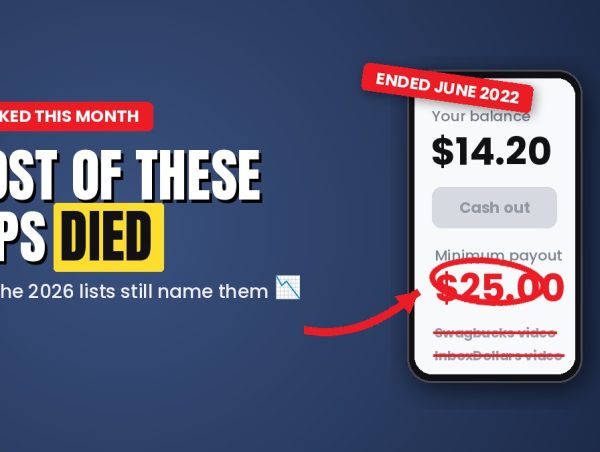
In June 2022, both Swagbucks and InboxDollars closed their video-watching sections. They remain excellent for surveys and cashback. They no longer pay you to watch videos. Any 2026 list that still features “Swagbucks Watch” was not checked before publishing.
Here is what actually still runs video offers, what the money looks like, and the single rule that decides whether you ever see any of it.
What still runs video offers
| Platform | Typical pay | Minimum cashout | Payout |
| MyPoints | 1–5 points per video | $10 | PayPal, gift cards |
| iRazoo | 1–3 points per video | $5 | PayPal, gift cards |
| GrabPoints | 2–10 points per video | $3 | PayPal, gift cards |
| QuickRewards | $0.01–$0.02 per video | $5 | PayPal, gift cards |
| AppKarma | 10–50 points per offer | $5 | PayPal, gift cards |
| HideoutTV | Variable points | Via partner site | Partner payout |
Points-based platforms obscure the rate deliberately. Translated: roughly $0.01 to $0.04 per video, on clips of 15 to 30 seconds, with daily caps.
The honest ceiling
This is the part worth being blunt about. Across the whole category, running several platforms daily, roughly $25–$30 a month is the practical ceiling for video watching alone. Not per week. Per month.
That is not a failure of effort. It is the design. Advertisers pay a fixed amount per impression and the platform keeps most of it, so the caps exist to stop you from costing them money. More hours do not raise the ceiling; they just hit it faster.
Which means the honest use of this method is narrow but real: it is the fastest way to confirm that getting paid to watch is not a scam, before you invest an afternoon in the profiles and screeners the better-paying methods require.
The cashout rule that traps your first $14
Here is the detail that costs people the most, and it is not the hourly rate.
Every platform has a minimum cashout. Earning $14 on a platform with a $25 minimum means you have earned nothing you can spend. And because the rate is so low, reaching a $25 minimum takes most people the better part of a year — long enough that the real risk shows up: inactivity expiry.
Most reward platforms void your balance after a period of no activity, commonly 3 to 6 months. People earn $14, lose interest, come back the following year, and find zero.
So the rule is simple and it decides everything:
- Start only on platforms with a $3–$5 minimum — GrabPoints, iRazoo, QuickRewards, AppKarma. You will reach a real payout in weeks instead of months.
- Avoid spreading across five platforms. Five balances of $4 each is $20 you cannot withdraw. One balance of $20 is $20.
- Cash out the moment you cross the minimum. Do not build a balance. There is no bonus for saving, and there is an expiry for waiting.
Three things that waste your time here
🚩 Apps that require another signup first
Some video platforms route their payouts through a second partner site you also have to join. That is two accounts, two minimums and two expiry clocks for one small balance.
🚩 Anything paying in cryptocurrency
Converting $6 of a token through an exchange costs more in fees and time than the $6 is worth.
🚩 Any app asking you to pay first
No legitimate reward platform charges an entry, training or verification fee. This is the oldest tell there is.
Your first week
- Day 1: Pick one platform with a $3–$5 minimum. One, not four.
- Day 2–6: Run video offers during time you were already losing — commutes, queues, adverts you would sit through anyway. Do not set aside dedicated hours for this; the rate does not justify them.
- Day 7: Cash out whatever you have, even if it is small. The point is to prove the payout works.
Is it worth it?
As an income, no. As a one-week proof that the category is real, yes — and that is genuinely useful before committing to anything bigger.
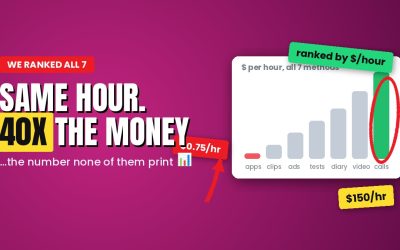
Once you have had a payout land, the hours are better spent one tier up. Website tests pay $10 for 20 minutes — roughly 40 times this rate per hour — and the setup takes a single afternoon. If you would rather keep the no-commitment feel, captioning and clipping also let you work whenever you like, at several times the rate.
We ranked every method by realistic hourly pay here: the full comparison.
Rates shown are published or self-reported figures and are not a guarantee of earnings. This article is for informational purposes only and does not constitute financial advice.